


Friends who are familiar with SY-PARTS know that SY-PARTS not only manufactures and sells brake system parts such as brake master cylinders, brake wheel cylinders, clutch master cylinders, clutch slave cylinders, brake calipers, etc., but also sells and customizes the repair kits and cups for these products. Today, we will briefly introduce the knowledge of O-rings that are sometimes seen in repair kits.
(Ⅰ). Overview of O-Ring and Sealing Principle
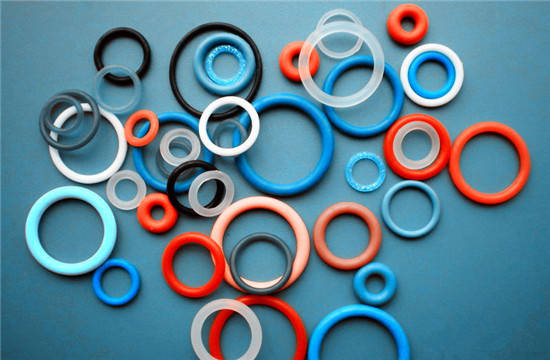
O-rings, commonly called O-rings, are a type of rubber ring with a circular cross-section. O-rings are the most widely used seals in hydraulic and pneumatic systems. O-rings have excellent sealing properties and can be used in static and dynamic sealing. They can be used alone and are also the basic components of many combined sealing devices. They have a wide range of applications. As long as the material is properly selected, it can adapt to the requirements of various media and various motion conditions.

O-rings are a type of extrusion seal. The basic operating principle of an extrusion seal is to rely on the elastic deformation of the seal to create contact pressure on the seal contact surface. If the contact pressure is greater than the internal pressure of the fluid being sealed, no leakage will occur; otherwise, leakage will occur.
(II) Compression Rate and Stretching
O-rings are typical extrusion seals. The compression rate and stretching of the O-ring cross-sectional diameter are the core contents of seal design and are of great significance to sealing performance and service life. The good sealing effect of O-rings depends largely on the precise matching of the O-ring size and groove size to form a reasonable compression and stretching of the seal.

2.1. Compression ratio
Compression ratio W is usually expressed by the following formula:
W=(d0-h)/d0 × 100%.
Where d0 is the cross-sectional diameter of the O-ring in the free state (mm);
h is the distance between the bottom of the O-ring groove and the sealed surface (groove depth), i.e., the cross-sectional height of the O-ring after compression (mm).
When selecting the compression ratio of an O-ring, the following three aspects should be considered:
①. There must be sufficient sealing contact area;
②. Friction should be as low as possible;
③.Avoid permanent deformation as much as possible.
It is not difficult to see that there are contradictions between the above factors.
A large compression ratio can achieve a larger contact pressure, but a compression ratio that is too large will undoubtedly increase sliding friction and cause permanent deformation. If the compression rate is too small, it is possible that a part of the compression amount will disappear due to the coaxiality error of the seal groove and the error of the O-ring not meeting the requirements, causing leakage. Therefore, when selecting the compression rate of an O-ring, it is necessary to consider various factors. Generally speaking, the compression rate of a static seal is higher than that of a dynamic seal, but its extreme value should be less than 25%, otherwise the compressive stress will be significantly relaxed, resulting in excessive permanent deformation, which is especially serious under high temperature conditions.
The selection of the compression ratio W of the O-ring should be based on the application conditions, whether it is a static seal or a dynamic seal. Static seals can be further divided into radial seals and axial seals. The leakage gap of radial seals (or cylindrical static seals) belongs to the radial gap, while the leakage gap of axial seals (or flat static seals) belongs to the axial gap. Axial seals are divided into two situations: internal pressure and external pressure, depending on whether the pressure medium acts on the inner or outer diameter of the O-ring. Internal pressure will increase the O-ring's elongation, while external pressure will reduce the O-ring's initial elongation.
For the various types of static seals mentioned above, the sealing medium has different directions of action on the O-ring, so the design of the preload is also different. For dynamic seals, it is also necessary to distinguish between a reciprocating seal and a rotary seal.
①.When using Static seal: The cylindrical static seal device is the same as the reciprocating seal device, generally taking W=10%~15%; the flat static seal device takes W=15%~30%.
②.When using dynamic seals:
- For reciprocating motion, select a compression rate (W) of 10% to 15%.
- For rotary motion seals, consider the Joule heat effect and use an O-ring with an inner diameter 3%-5% larger than the shaft diameter, and an outer diameter compression rate (W) of 3%-8%.
- For low-friction motion, choose a compression rate of 5%-8% to reduce friction resistance and consider the material's expansion due to the medium and temperature, with a maximum allowable expansion rate of 15%.
If this range is exceeded, it means that the material selection is inappropriate and O-rings of other materials should be used instead, or the given compression deformation rate should be corrected.
2.2 The Stretching Amount
After the O-ring is installed in the sealing groove, it will generally undergo a certain amount of stretching. Like the compression rate, the amount of stretch has a great influence on the sealing performance and service life of the O-ring. A large amount of stretching will not only make the O-ring difficult to install, but also reduce the compression rate by changing the cross-sectional diameter d0, which may cause leakage.
The stretching a can be expressed by the following formula:α =(d+d0)/(d1+d0)
where d is the shaft diameter (mm) and d1 is the inner diameter of the O-ring (mm).
The range of the stretching amount is 1%-5%. The table shows the recommended values of O-ring stretching amount. According to the shaft diameter size, the O-ring stretching amount can be selected according to the table.
The range of O-ring compression rate and stretching amount:
|
Seal type |
Sealing medium |
Stretching amount α (%)
|
Compression ratio w (%) |
|
Static seal |
Hydraulic oil |
1.03~1.04 |
15~25 |
|
Air |
<1.01 |
15~25 |
|
|
Reciprocating motion |
Hydraulic oil |
1.02 |
12~17 |
|
Air |
<1.01 |
12~17 |
|
|
Rotary motion |
Hydraulic oil |
0.95~1 |
3~8 |
Relationship between hardness of various O-ring rubber materials and working pressure:
|
Hardness (Shore A)/degree |
50±5 |
60±5 |
70±5 |
80±5 |
90±5 |
|
Working pressure static seal/≤Mpa |
0.5 |
1 |
10 |
20 |
50 |
|
Working pressure (reciprocating motion, reciprocating speed ≤0.2m/s)/Mpa |
0.5 |
1 |
8 |
16 |
24 |
Note: The working pressure of the rotary motion does not usually exceed 0.4 Mpa and the hardness is selected at (70±5) degrees; if it exceeds 0.4 Mpa, a special sealing device should be designed.
Japan JISB 2406-1991 recommended maximum clearance of O-ring seal/mm
|
Working pressure/Mpa
Hardness (Shore A)/degree |
≤0.4 |
4.0~6.3 |
6.3~10 |
0~16 |
16~25 |
|
70 |
0.35 |
0.30 |
0.15 |
0.07 |
0.03 |
|
90 |
0.65 |
0.60 |
0.50 |
0.30 |
0.17 |
The U.S.A SAE J120A-1968 recommended maximum clearance of O-ring seal/mm
|
Hardness (Shore A)/degrees Working pressure/Mpa |
70 |
80 |
90 |
|
0 |
0.254 |
0.254 |
0.254 |
|
1.72 |
0.254 |
0.254 |
0.254 |
|
3.45 |
0.203 |
0.254 |
0.254 |
|
6.89 |
0.127 |
0.203 |
0.254 |
|
10.34 |
0.076 |
0.127 |
0.203 |
|
13.79 |
0.102 |
0.127 |
|
|
20.68 |
0.076 |
0.102 |
|
|
34.47 |
0.076 |
Relationship Between O-Ring Diameter and Shaft Speed
|
Speed/m/s |
O-ring cross-sectional diameter/mm |
Speed/m/s |
O-ring cross-sectional diameter/mm |
|
2.03 |
3.53 |
7.62 |
1.78 |
|
3.05 |
2.62 |
The relationship between NBR rubber hardness and pressure resistance
|
Hardness (Shore A)/degrees |
Tensile strength/Mpa |
Elongation/% |
Applicable pressure range/Mpa |
|
80 |
22 |
400 |
2 |
|
85 |
27 |
306 |
20 |
|
90 |
25 |
120 |
50 |
(III) Sealing groove shape
3.1 Various groove shapes for installing O-rings
|
Name of the shape of the groove |
Application |
|
Rectangular Groove |
This is a common groove shape suitable for both moving and fixed seals. |
|
V-shaped groove |
Suitable for fixed seals only. When used as a moving seal, the frictional resistance is very large, and it is easy to squeeze into the gap and cause damage. |
|
Semicircular Groove |
It can be used for rotating seals, but it is generally not used. |
|
Dovetail Groove (Trapezoidal Groove) |
It is used in cases where the frictional force requirement is very low. Since the groove machining cost is high, it is generally not used. |
|
Triangular groove |
It is recommended for stationary seals. |
3.2 Surface finish of O-ring rubber seal groove mating parts
|
Surface |
Application |
Pressure conditions |
Surface finish |
|
Groove bottom and sides |
Static seal |
Non-alternating and no pulse |
R 3.2μm |
|
Alternating or pulse |
R 1.6μm |
||
|
Dynamic seal |
Non-alternating and no pulse |
||
|
Mating surface |
Static seal |
Non-alternating and no pulse |
R 1.6μm |
|
Alternating or pulse |
R 0.8μm |
||
|
Dynamic seal |
R 0.4μm |
Note: Groove finish and contact surface roughness will affect sealing performance and durability.
Disclaimer: The information is taken from the Internet. Our goal is to spread automotive knowledge. If there is any infringement, please contact the editor to remove it.