


1.Fluid Motion

Flow rate is the movement of a specific volume of fluid in a certain amount of time. Flow rate is usually measured in gallons per minute (gpm) or liters per minute (lpm) using a flow meter.
Flow velocity is the distance a specific volume of fluid moves in a certain amount of time. Flow velocity is not measured directly but is calculated using the flow rate and the cross-sectional area of the pipe.

Flow velocity is directly dependent on flow rate and pipe size. If we change the flow rate of the pump but keep the pipe size the same, we can change the flow velocity of the fluid.

If we keep the pump size the same, but change the pipe size, we get the same effect.

As the flow velocity increases, the heat also increases. This is because of the effect of friction.

Friction is caused by the fluid molecules rubbing against the inner surfaces of the hoses and pipes.

2.Laminar Flow
We imagine fluids to flow in a single mass, but this is not true. At low speeds, fluids flow in different parallel layers. Each of these layers moves at a slightly different speed. This state is called laminar flow.

3.Turbulent
As the velocity of the fluid increases, tiny imperfections on the surface of the flow conductor (hose or pipe) disturb the flow path. This creates a chaotic state instead of an ordered laminar layer. This turbulence (due to friction) causes an increase in heat.

Turbulence occurs wherever there are bends and restriction in a hydraulic system. Keeping hoses and fittings large helps minimize this effect.

4.Pascal's Principle
Pascal's Principle states that any pressure applied to a confined fluid is transmitted with equal force in all directions.

But this is only the case when the liquid is in a closed container.
5.Pressure
Pressure is created by the resistance to the flow of a fluid, called dynamic pressure, or by the potential energy of an object affected by gravity, called static pressure.

Static pressure is created when a fluid wants to flow but can't. Gravity tries to push the cylinder rod down, but because the valve is closed, the fluid in the cylinder can't escape. As the force pushes the cylinder rod down, the trapped fluid gains energy. This energy is the pressure value shown on the gauge.
Dynamic pressure, on the other hand, is related to the kinetic energy of the fluid.

Therefore, as the resistance to flow increases, the pressure also increases.
When the fluid flows through the restriction, the pressure drops due to the energy conversion (friction produces heat).

6.Bernoulli's Principle
Because the total energy of a system must remain constant, Bernoulli's principle states that if kinetic energy (fluid velocity) decreases, potential energy (pressure) must increase proportionally.
7.Surface Area
Surface area is the total exposed area of a solid object.

In hydraulic systems, we focus on the surface area of the components that interact with the fluid. The surface area of a component can have a huge impact on how the system works!
8.FPA Triangle
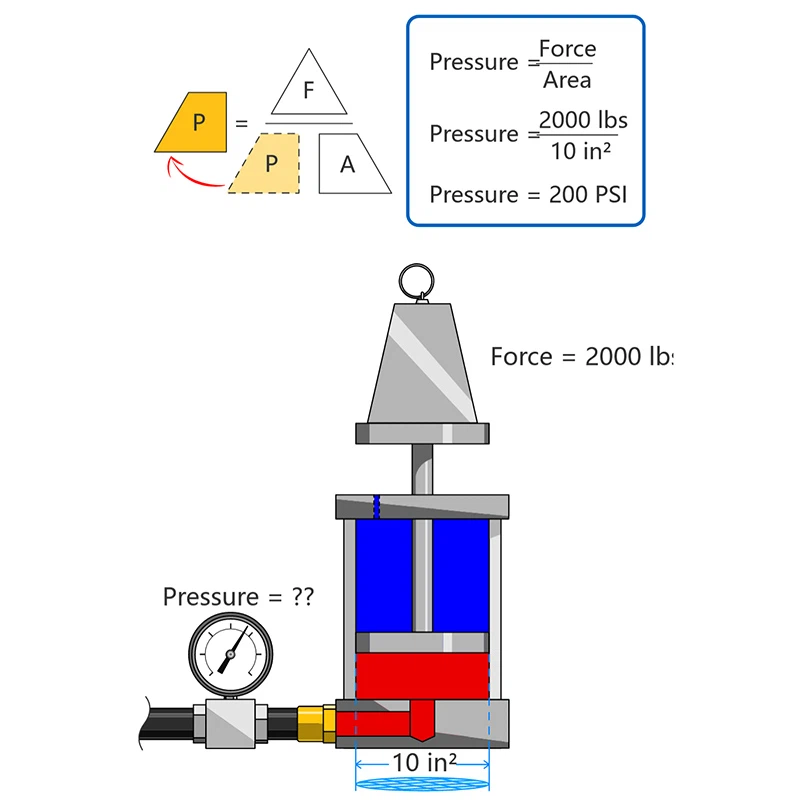
There is a direct mathematical relationship between the force a hydraulic system can transmit, the pressure in the system, and the surface area of the components being driven.

This relationship is often represented by the FPA triangle.
If we know the pressure and the piston surface area, we can calculate the force.

If we know the force required and the pressure available, we can calculate the required piston surface area.

Alternatively, if we know the force and the surface area of the piston, we can calculate the pressure.
9.Amplification of Force
By using a smaller surface area on the left cylinder, we can increase the force on the right cylinder.

10.Basic Knowledge Concepts
As you learn more about hydraulic systems and design, these concepts will continue to appear. In summary, hydraulics is faced with these very basic knowledge concepts.
Fluid movement:Flow, Velocity, Laminar Flow,Turbulence/Turbulent, Friction
Pressure:Static Pressure, Dynamic Pressure, Throttling loss(Restrictions)
Surface area: Force, Force Multiplication
Basic principles: Bernoulli Principle, Pascal's Principle, FPA Triangle.

Disclaimer: The distribution of this article is for the sole purpose of disseminating automotive technical knowledge.If you have any objections to infringement, please contact us for negotiation or deletion. Thank you very much!