


Understanding the Braking System
1.Braking System
Slowing or even stopping a moving car, keeping a car moving downhill at a stable speed, and keeping a stopped car stationary are collectively referred to as automobile braking. The external force that brakes the car is the brake system.
The brake system consists of brakes and brake actuation mechanisms. Brakes are components of the braking force that impede the movement or movement tendency of the vehicle, including the retarder in the auxiliary braking system. The brake drive mechanism includes functional devices, control devices, transmission devices, brake force adjustment devices, and auxiliary devices such as alarm devices and pressure protection devices.
There are many types of automotive braking systems, which can be divided into the following categories according to their functions:
①.Service braking system: a device that slows or even stops the vehicle.
②.Parking Brake System: a device that holds a stopped vehicle in place.
③.Secondary braking system: a device that ensures that the car can still slow down or stop if the service braking system fails.
④ .Auxiliary braking system: a device used to stabilize the speed of the vehicle when the vehicle is going down a long incline.
The brake system can be divided into the following categories according to the braking energy:
①.Manpower Braking System: A braking system that uses the driver's body as the sole source of braking energy.
②.Power Braking System: A braking system that relies solely on potential energy in the form of air pressure or hydraulic pressure converted from engine power for braking.
③.Servo braking system: a braking system that uses both human power and engine power for braking.
The brake system can also be classified according to the gas-hydraulic circuit:
①.Single-circuit brake system: The transmission uses a single gas-hydraulic circuit. If one part is damaged, the whole system will fail.
②.Dual-circuit brake system: The service brake's gas-hydraulic lines belong to two isolated circuits. This ensures that if one circuit is damaged, the entire system can still function normally. Since January 1, 1988, China has required that all cars be equipped with a dual-circuit braking system.
2. Brakes
The brake is a braking force component in the braking system that is used to generate braking force to stop the movement or tendency of the vehicle. When the braking torque of the brake is applied directly to the wheel, it is called a wheel brake; when the braking torque must be distributed to the wheel after passing through the drive axle, it is called a center brake. Wheel brakes are generally used for drive brakes and are also used for secondary and parking brakes; central brakes are generally used only for parking and auxiliary brakes. Driving brakes, parking brakes and secondary brakes basically use the frictional force generated by fixed elements and rotating elements as a braking force, which is called a friction brake. The friction brakes currently used in automobiles can be roughly divided into two categories: disc type and drum type.
2.1 Drum Brakes

Drum brakes use the brake drum as the rotating element in the friction pair, and its working surface is a cylindrical surface. Drum brakes can be divided into wheel cylinder brakes, cam brakes and wedge brakes according to their construction. Wheel cylinder brakes use hydraulic brake wheel cylinders as the actuating device, and use hydraulic actuation to bring the brake shoe into contact with the brake drum to generate friction, thereby braking. According to the working principle and braking torque, there are many types, including leading shoe type, double leading shoe type, two-way double leading shoe type, double following shoe type and self-energizing type. The structure of cam brakes and wedge brakes is basically the same as that of wheel cylinder brakes, and only the actuating device is different. The cam type uses a brake cam, and the wedge type uses a brake wedge.
2.2 Disc Brakes

The friction element in the friction pair of a disc brake is a metal disk that works on the face, and this disk is called the brake disk. Compared with drum brakes, disc brakes have the following advantages:
①. Braking performance is stable and less affected by the friction coefficient;
②. The disc brake transfers heat to both sides, and the disc is easily cooled and not easily deformed;
③. After long-term use, the thermal expansion of the brake disk along the thickness direction is extremely small;
④. The braking performance is less reduced after immersion in water;
⑤. The structure is simple, the size and weight are small, the maintenance is convenient, and the automatic gap adjustment is easy to achieve.
The main drawback is low braking efficiency. To compensate for this, a power servo system is usually installed separately. At present, disc brakes are widely used in automobiles. Disc brakes can be roughly divided into caliper disc type and full disc type according to their different mounting elements. Compared with the two, the caliper disc type has a wider application, so I will focus on it here.
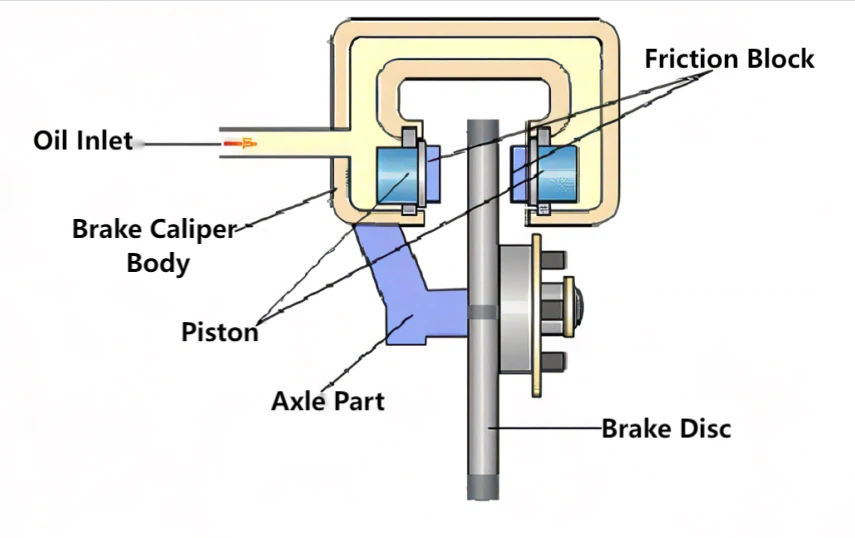
The caliper disc brake consists of a brake disc and a brake caliper. The brake pad, which is composed of the friction block and its metal back plate, and its actuator are installed in a clamp-shaped bracket to form a brake caliper. The brake caliper can be divided into two types: fixed caliper disc type and floating caliper disc type.
The working principle of the fixed caliper disc brake is as follows. Its caliper body is fixed to the axle, and there is a brake wheel cylinder and piston on each side of the caliper body. When braking, the oil from the master cylinder enters the two identical hydraulic cylinders in the caliper body through the oil inlet, and the friction pad is pressed onto the brake disk by the piston, thereby braking the wheel.
The working principle of floating caliper disc brake is as follows. Compared with fixed caliper disc brake, the caliper of floating caliper disc brake is floating and can move relative to the brake disk. It only uses a hydraulic cylinder on the inside of the brake disk to drive the inner pad, while the outer pad is fixed to the caliper body and moves axially with the caliper body. When braking, the inner piston and friction plate move to the left and press against the brake disk under the hydraulic force. At the same time, the reaction force of the hydraulic pressure pushes the caliper body to move to the right, so that the outer friction plate is also pressed against the brake disk, thereby achieving the braking effect.

3. Servo Brake System
The servo brake system is formed by adding a power servo system to the manual hydraulic brake system, i.e. a brake system that uses both manpower and the engine as braking energy. Under normal circumstances, most of the braking energy is supplied by the power servo system. If the power servo system fails, it can be completely supplied by the driver. The servo brake system can be divided into the following types according to the type of servo energy:
① Vacuum servo type
② Pneumatic servo type
③ Hydraulic servo type
According to the different operation modes of the controller, it can be divided into two categories:
①.Power-assisted type - the control device is directly operated by the brake pedal mechanism, and its output force also acts on the hydraulic master cylinder.
②.Supercharged type - the control device is operated by the hydraulic pressure output from the brake pedal mechanism through the master cylinder, and the output force of the servo system and the hydraulic pressure of the master cylinder jointly act on an intermediate transmission cylinder, so that the hydraulic pressure output from the cylinder to the wheel cylinder is much higher than the hydraulic pressure of the master cylinder.
Here is a detailed introduction to the vacuum servo brake system. The vacuum booster in the system has a diaphragm that divides it into front and rear chambers. The front chamber is connected to the engine's intake manifold by a vacuum one-way valve, and the rear chamber is connected to the outside air. The two chambers are connected by a channel. When the engine is running, the vacuum one-way valve opens and closes, and a certain amount of vacuum is created in the front and rear chambers of the vacuum booster. If the brake pedal is depressed at this time, the brake pedal will further actuate the control valve to close the channels of the front and rear chambers of the servo air chamber and open the rear chamber intake valve. The air entering the rear chamber creates a vacuum differential with the front chamber, creating thrust. This thrust acts directly on the master cylinder to compensate for the lack of pedal force.

The schematic diagram of the vacuum booster servo brake system is as follows. When the engine is running, under the action of the vacuum in the intake pipe, the air in the vacuum tank is sucked into the engine through the vacuum check valve, thereby generating and accumulating a certain vacuum in the tank, which serves as the energy source in the servo brake system. When the brake pedal is depressed, the output hydraulic pressure of the master brake cylinder is first transmitted to the auxiliary cylinder, one side is transmitted to the brake wheel cylinder as brake actuating pressure, and the other side is input to the control valve as control pressure. Under the control of the hydraulic pressure of the master cylinder, the control valve allows the working chamber of the Zhenkang servo air chamber to pass through the vacuum tank or the atmosphere, and ensures that the output force of the servo air chamber is in an increasing functional relationship with the hydraulic pressure of the master cylinder, the brake pedal force, and the pedal stroke. The output force of the vacuum servo air chamber acts on the auxiliary cylinder together with the hydraulic force from the master cylinder.

4,Power Brake System
In the power brake system, the energy used for braking is the air pressure energy generated by the air compressor or the hydraulic energy generated by the hydraulic pump, and the air compressor or the hydraulic pump is driven by the vehicle engine. Therefore, it can be seen that the power brake system uses the vehicle engine as the only initial braking energy source, and the driver's body is used only as a control energy source, not as a braking energy source. The power brake system can generally be divided into the following three categories:
①. Pneumatic brake system: The energy supply device and transmission device are all pneumatic. Most of the control devices consist of pneumatic control elements such as brake pedal mechanisms and brake valves.
②. Air-over-fluid brake system: The energy supply device and control device are the same as those of the pneumatic brake system, and the transmission device includes pneumatic and hydraulic parts.
③. Full hydraulic power brake system: Except for the brake pedal mechanism, its power supply, control and transmission devices are all hydraulic.
5,Brake Force Adjustment System
In theory, the greater the braking force, the easier it is to brake. However, if the braking force is greater than the adhesion force, the wheels will stop turning and the wheels will slip. If the front wheels are locked, the car will lose directional control and be unable to turn; if the rear wheels are locked and the front wheels roll, the car will lose directional stability and the ability to resist lateral forces and slip. Based on the above situation, we need to distribute and adjust the braking force to avoid the above situation.
5.1 ABS
ABS - Antilock Brake System. The system consists of three parts: wheel speed sensor, electronic controller and hydraulic components.

The specific work processes are roughly as follows:
① Conventional braking: The solenoid valve is not energized, and the master cylinder and wheel cylinder can control the increase and decrease of brake pressure at any time.
② Wheel cylinder decompression: When the vehicle speed sensor inputs the wheel lock signal to the electronic control unit, the ABS starts working, a large current is input to the solenoid valve, the plunger moves upward, the master cylinder and the active wheel cylinder passage are cut off, the wheel cylinder and the reservoir are connected, the brake fluid flows into the reservoir, and the brake pressure is reduced. At the same time, the drive motor starts the hydraulic pump, pressurizing the brake fluid flowing back to the reservoir and delivering it to the master cylinder in preparation for the next brake application.
③ Wheel cylinder pressure maintenance process: When the vehicle speed sensor outputs a lock signal, the solenoid valve passes a limited current and the plunger moves to a position where all passages are cut off to maintain system pressure.
④ Pressurization of the wheel cylinder: After the pressure is reduced, the wheel speed increases. At this time, the electronic control unit cuts off the current to the solenoid valve, the plunger returns to the lowest position, the master cylinder and wheel cylinder are reconnected, brake fluid enters the wheel cylinder again, and brake pressure is increased.
5.2 EBD
EBD - Electric Brake Force Distribution, an electrically controlled brake force distribution system. EBD is actually an auxiliary function of ABS. It is a control software added to the ADAS control computer. The mechanical system is exactly the same as ABS. It is an effective complement to the ABS system. It is usually used in combination with ABS to improve the effectiveness of ABS. At the moment of braking, EBD can quickly calculate the different friction values caused by the different adhesion of the four tires, and then quickly adjust the braking device to distribute the braking force according to the previously set program, so as to ensure the stability and safety of the vehicle. When the wheels are locked during emergency braking, EBD has balanced the effective ground adhesion of each wheel before ABS, which can prevent skidding and sideways movement, and also shorten the stopping distance.
5.3 ASR
ASR - Acceleration Slip Regulation, anti-skid system of the vehicle drive. This function can be understood as an extension and supplement to the function of the ABS system. The main components of the ASR system can be shared with the ABS system. The function of the ASR system is to prevent the vehicle from slipping during acceleration, especially on asymmetrical, low-friction roads or when the drive wheels are spinning idly during cornering. ASR consists of a wheel speed sensor, a throttle position sensor, a brake pressure regulator, a throttle actuator and an electronic control unit. It can compare the wheel speed of each wheel when the drive wheel slips. If the electronic control unit determines that the drive wheel is slipping, it automatically and immediately reduces the throttle intake volume, reduces the engine speed, and thus reduces the power output. It can also brake the slipping drive wheel to control the drive wheel slip rate within the target range.
5.4 TCS
TCS - Traction Control System. This system determines whether the drive wheel is slipping based on the number of revolutions of the drive wheel and the number of revolutions of the transmission wheel. If the former is greater than the latter, it reduces the speed of the drive wheel. TCS is very similar to ABS in that both use sensors and brake controllers. When TCS senses wheel slip, it first changes the engine ignition timing through the engine control computer, reduces engine torque output, or applies wheel brakes to prevent the wheel from slipping. If the slippage is very severe, it will control the engine's fuel supply system. TCS uses a computer to detect the speed of the four wheels and the steering angle of the steering wheel. When the car accelerates, if it detects that the speed difference between the driving wheel and the non-driving wheel is too large, the computer immediately determines that the driving force is too large and sends a command signal to reduce the engine fuel supply, reduce the driving force, and thus reduce the slip rate of the driving wheel tire. The system can use the steering wheel angle sensor to detect the vehicle's driving state, determine whether the vehicle is going straight or turning, and change the slip rate of each tire accordingly. However, the traction control system also has drawbacks. When the driver uses the accelerator opening to adjust the vehicle's driving state, the system interferes with the driver's driving intention.
5.5 ESP
ESP - Electronic Stability Program. ESP can actually be seen as a combination and extension of the functions of ABS, ASR, EBD and TCS. It consists of a steering sensor, a wheel speed sensor, a slip sensor, a lateral acceleration sensor and a control unit. By analyzing the driving status of the vehicle body based on the information provided by the various sensors, it then issues correction instructions to ABS and ASR to help the vehicle maintain dynamic balance. ESP can maintain optimum vehicle stability under a variety of operating conditions, and is particularly effective under understeer or oversteer conditions. If the ESP sensor detects that the vehicle is understeering, ESP applies additional braking force to the inside wheels; if the vehicle is oversteering, ESP applies additional braking force to the outside wheels.