


Introduction
Since Karl Benz built the first single-cylinder three-wheeled automobile in 1885, vehicles have accompanied human social development for over a century. The braking system, as the critical safety system of a vehicle, has continuously evolved alongside automotive progress. As the heart of hydraulic braking system energy delivery, the hydraulic brake master cylinder has been repeatedly redesigned and improved.
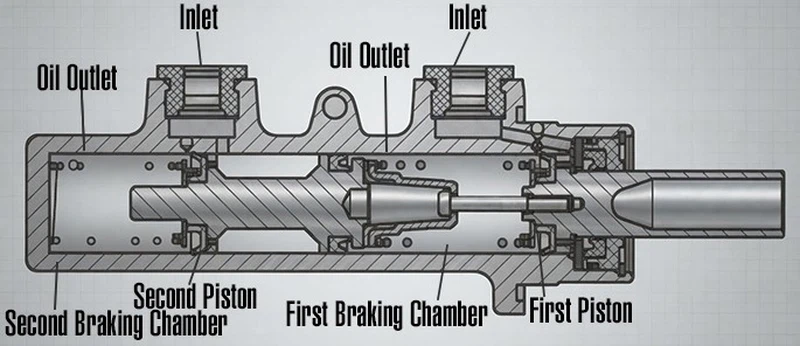
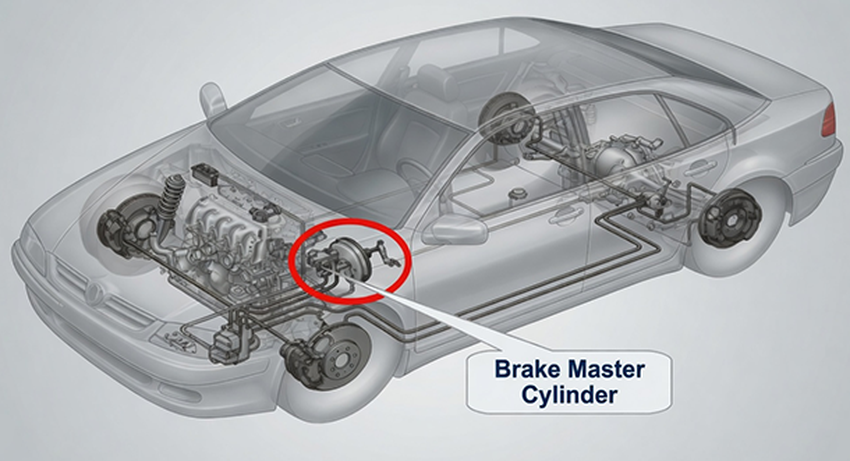
The development trajectory of the brake master cylinder can be traced through several major stages: the single-circuit master cylinder, the residual-pressure-valve type, the dual-circuit (tandem) master cylinder, and configurations designed to accommodate Anti-lock Braking System (ABS) and Electronic Stability Program (ESP) requirements. At each stage, variations emerged to address specific design and performance needs. This paper discusses each major configuration's development path, structural features, operating principles, and manufacturing considerations.
Before 1967, most automotive master cylinders were simple affairs-a single reservoir with one piston and one seal. This architecture had a significant drawback: if a wheel cylinder leaked, a brake line failed, or the single internal seal went bad, the driver could lose braking entirely.
The breakthrough toward safety redundancy came in 1962, when Cadillac introduced a dual-circuit braking system with separate front and rear hydraulic lines. If one circuit suffered a leak, the other could still stop the vehicle. American Motors also adopted split-cylinder systems early on, though their diagonal-split architecture divided circuits between one front wheel and one rear wheel on opposite sides-a design that improved safety but was not yet a complete front-rear separation.
Several manufacturers worked independently on dual-cylinder systems offering built-in redundancy. Wagner Electric was among the first to succeed. The real turning point arrived in 1967, when the U.S. Federal Government mandated that all vehicles must be equipped with a dual-brake master cylinder with separate circuits in case of line failure or other failures.
Today's dual-circuit master cylinders typically feature two separate chambers separating the front and rear brake circuits, though some configurations still split diagonally. This arrangement prevents total loss of braking if one seal fails or a pressure leak develops. More than 75% of braking is performed by the front wheels, meaning that rear brake failure may go unnoticed by the driver, but the front remains fully functional.
Operationally, when the brake pedal is depressed, force is transmitted through the push-rod to the master cylinder piston. The piston incorporates two seals and moves within two chambers, with a line dedicated to each circuit. As the pistons are forced forward, hydraulic pressure builds and moves larger pistons in the calipers or wheel cylinders, stopping the wheels.

Plunger-Type Dual-Circuit Brake Master Cylinder
1.1 General Description
The plunger-type dual-circuit brake master cylinder-also referred to in some industry literature as the portless or center-feed type-represents a fundamental departure from conventional master cylinder architecture. Rather than placing compensation ports in the cylinder bore wall, this design locates the compensation passages on the piston itself. This seemingly simple repositioning carries significant implications for system integration, durability under ABS/ESP cycling, and compact packaging.
The plunger-type master cylinder is structurally compact. Its internal components telescope together like antenna sections, allowing the overall assembly to extend and retract smoothly. This telescoping arrangement significantly reduces axial installation length-typically about half that of conventional master cylinders-while simultaneously meeting the stringent hydraulic flow demands of modern ABS and ESP systems.
1.2 Structural Characteristics
The most distinctive feature of the plunger-type master cylinder is the placement of compensation ports on the piston rather than in the cylinder bore wall. This design eliminates the sharp edge of a conventional bore-side port, which historically was a primary failure site for primary cup seals. It also provides a much larger total compensation flow area-multiple ports can be arranged around the piston circumference.
Additionally, because the entire effective length of the piston is utilized for sealing contact with the cylinder bore wall, the overall length of the cylinder body can be substantially reduced.
1.3 Operating Principle
At rest, the primary and secondary circuits are open to the reservoir via the piston-mounted compensation ports. When the driver depresses the brake pedal, the primary piston moves forward. The compensation ports travel past the primary cup seal, which now rides against a smooth uninterrupted bore surface. Once the ports are bypassed, the pressure chamber is sealed and hydraulic pressure builds, delivering fluid to the brake circuits.
Upon pedal release, the piston returns under spring force. The compensation ports re-enter the area past the primary cup seal, re-establishing communication between the pressure chamber and the reservoir, allowing fluid to flow back and replenish the chamber as needed.
1.4 Key Differences from Conventional Master Cylinder Designs
- 1.4.1 Significantly Reduced Axial Length
Because internal components telescope within one another, the total assembly length can be drastically shortened-often to roughly half that of a conventional tandem master cylinder of comparable bore diameter and output volume. This packaging advantage is critical for vehicles with tight engine compartment layouts.
-
1.4.2 Direct Compatibility with ABS Systems
Conventional master cylinders with bore-wall compensation ports have shown high rates of primary cup seal damage when used with ABS. The reason lies in the operating dynamics of ABS: during active ABS cycling, the system repeatedly releases and re-pressurizes brake fluid. This causes the master cylinder piston to oscillate within a narrow range. In a conventional design, this oscillation frequently positions the primary cup seal exactly at the location of the compensation port. Under high pressure, the seal cup is forced into the port opening, leading to rapid seal wear, cuts, or extrusion failure.
In the plunger-type design, the compensation ports travel with the piston. The primary cup seal contacts only a smooth cylinder bore wall throughout its entire stroke range. No port edge contacts the seal at any piston position, virtually eliminating this failure mode.
-
1.4.3 Compatibility with ESP High-Flow Demands
Electronic Stability Program (ESP) systems, increasingly mandated globally, require the master cylinder to deliver large volumes of brake fluid in very short time intervals for automatic brake intervention. The plunger-type design accommodates this requirement through its ability to incorporate multiple large compensation ports arranged around the piston circumference. This design has become the preferred architecture for vehicles equipped with ESP.
1.5 Manufacturing Specifications for Plunger-Type Master Cylinders
Proper sealing between the primary cup seal and the piston must be balanced against the need for fluid to bypass the cup seal during the compensation phase. Additionally, smooth sliding without binding requires precise control of bore roundness, piston straightness, and surface finish.
Bore Finish Specifications
| Parameter | Specification |
| Surface Roughness (Ra) | 0.2 – 0.4 μm |
| Bore Roundness | ≤ 4 μm |
| Bore Taper | ≤ 3 μm per 10 mm length |
| Micro-hardness after surface treatment | 400 – 600 HV |
Piston Specifications
| Parameter | Specification |
| Surface Finish (Ra) | 0.2 – 0.5 μm |
| Straightness | ≤ 5 μm over full length |
| Diameter Tolerance | ± 0.008 mm |
Seal Cup Specifications
| Parameter | Specification |
| Material | EPDM rubber compound approved for DOT3/DOT4 brake fluid |
| Hardness (Shore A) | 70 ± 5 |
| Tensile Strength (min) | 10 MPa |
| Elongation at break (min) | 250% |
2 Center Valve Dual-Circuit Brake Master Cylinder
2.1 General Description
The center valve-type master cylinder was specifically developed for use with ABS-equipped vehicles. Like the plunger-type design, it eliminates the conventional bore-wall compensation port, but achieves this through a different mechanism: an internal spring-loaded valve positioned at the center of each piston.
Patents describing center valve configurations for anti-lock hydraulic brake systems date back to the mid-1990s, with major manufacturers including Bosch developing their own production versions in the early 2000s. The design has proven particularly suitable for passenger car applications where packaging space is less constrained but ABS durability remains a priority.

2.2 Structural Characteristics
The defining feature of a center valve master cylinder is the complete absence of compensation ports in the cylinder bore wall. Instead, each piston incorporates an axial center valve-consisting of a small spring, a valve poppet or ball, and a sealing seat-that controls fluid communication between the pressure chamber and the reservoir. The cylinder bore is entirely smooth from the resting position through the full stroke length, providing an uninterrupted sealing surface for the primary cup seals.
This structure eliminates the sharp compensation port edge that damages primary cup seals in conventional designs.
2.3 Differences from Conventional Master Cylinder Designs
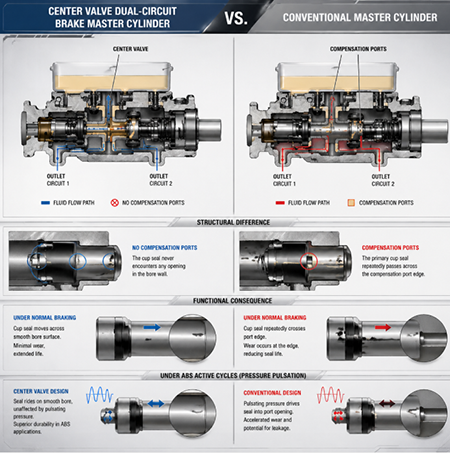
The fundamental difference is structural: center valve-type master cylinders incorporate a center valve and have no compensation ports. Conventional master cylinders have compensation ports and no center valve.
The functional consequence is equally significant. In a conventional design, the primary cup seal repeatedly passes across the compensation port edge during normal braking. This wear mechanism is substantially accelerated in ABS applications, where the piston oscillates rapidly near the port position. In center valve-type designs, the cup seal never encounters any opening in the bore wall, dramatically extending seal and cylinder life.
For ABS applications specifically, this difference is critical. When ABS active cycles cause pressure pulsations in the master cylinder pressure chambers, the primary cup seal in a center valve design simply rides across a smooth bore surface, unaffected by the pulsating pressure that would drive a conventional seal into a port opening.
2.4 Operating Principle
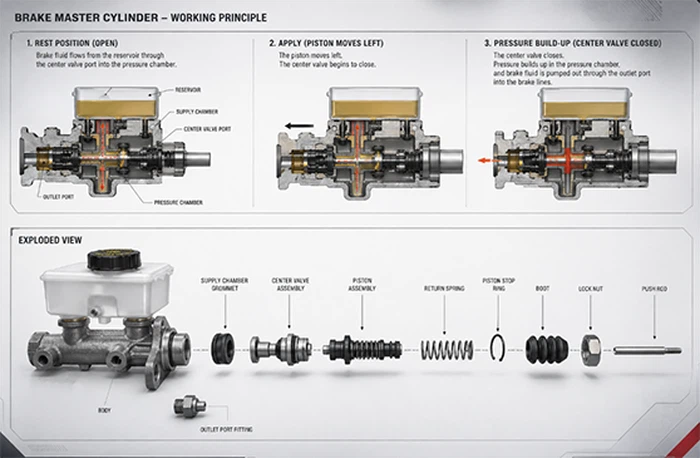
At rest, the center valve is held open by spring force and mechanical stop geometry. Brake fluid from the reservoir flows through the valve, around the poppet, and into the pressure chamber. When the driver depresses the brake pedal and piston movement begins, the valve spring force is gradually overcome, and the valve seat closes against the poppet. Once sealed, the pressure chamber is isolated from the reservoir, and further piston movement pressurizes the trapped fluid, delivering it to the brake circuits.
Upon pedal release, return spring pressure initially drops, the center valve spring re-opens the valve, and fluid flows back from the reservoir into the pressure chamber.
The center valve preload spring force must be carefully selected. When the preload force (F) divided by the effective sealing area yields a back-opening hydraulic pressure of less than 0.03 MPa, brake fluid compensation is accelerated, master cylinder return speed is improved, and manual brake fluid filling during assembly is facilitated.
2.5 Manufacturing Specifications for Center Valve Master Cylinders
The following specifications represent typical requirements for passenger vehicle applications:
Cylinder Bore Specifications |
|
| Parameter | Specification |
| Surface Roughness (Ra) | 0.2 – 0.4 μm |
| Bore Roundness | ≤ 3 μm |
| Hardness (after anodizing or similar treatment) | 350 – 500 HV |
Center Valve Specifications |
|
| Parameter | Specification |
|---|---|
| Valve preload spring force | 3 – 8 N (confirm against piston area) |
| Poppet/seat material | hardened steel or stainless |
| Seat finish | lapped, ≤ 0.1 μm Ra |
| Leakage at 0.5 MPa reverse pressure | 0 cc/min |
Assembly cleanliness standards |
|
| Contaminant Type | Specification |
|---|---|
| Metal particles (max particle size) | ≤ 70 μm |
| Non-metal particles (max particle size) | ≤ 600 μm |
| Metal particles (max % of total impurities) | 50% |
| Non-metal particles (max % of total impurities) | 50% |
| Total impurities per assembly | ≤ 10 mg |
3 Key Structural Trends and Observations
3.1 Regulation-Driven Development
The most important single driver of master cylinder evolution has been safety regulation. The 1967 U.S. mandate for dual-circuit braking systems transformed the entire industry. Similarly, the European Union's requirement that all new passenger vehicles be equipped with Anti-lock Braking Systems (ABS) from 2004 onward-and Electronic Stability Program (ESP) from 2014 onward-has fundamentally changed what a master cylinder must do.
The ABS requirement means master cylinders must now withstand pressure pulsations and seal oscillation without premature wear. The ESP requirement means master cylinders must deliver large fluid volumes instantly for automatic braking interventions. These requirements are not optional-they are the legal minimum for vehicle homologation in most major markets.

3.2 Global Regulatory Framework
For brake system components intended for export, awareness of the two dominant regulatory frameworks is essential.
- FMVSS 105 (U.S.) : Federal Motor Vehicle Safety Standard No. 105 covers hydraulic brake systems for passenger cars, multi-purpose passenger vehicles, trucks, and buses, mandating tests for stopping distance, brake force distribution, and system integrity.
- ECE R13 (EU and many other markets) : UN Regulation No. 13 covers uniform provisions for the approval of vehicles of categories M, N, and O with regard to braking. It is widely adopted across Europe, Asia, the Middle East, and beyond.
Modern vehicles must comply with one or both of these standards, and master cylinder design must accommodate the corresponding test protocols.
3.3 The Shift Toward Portless Architectures
Conventional bore-wall ports have demonstrated reliability issues under ABS cycling. Both the plunger-type and center valve-type designs eliminate the port edge, each through a different mechanism. Which architecture will ultimately dominate remains an open question, although the plunger-type design offers advantages in axial length and flow capacity that may prove decisive for future applications.
3.4 Integration with Electronic Control Systems
Electronic Stability Program (ESP) and the emerging generation of brake-by-wire systems demand master cylinders capable of rapid, high-volume fluid delivery, as well as integration with electronic control units and position sensors. Although fully autonomous vehicles (Level 4 and Level 5) may eventually reduce reliance on hydraulic components in favor of purely electronic braking, brake-by-wire is expected to maintain a hydraulic foundation for the foreseeable future.
Summary
The evolution of the brake master cylinder has followed two primary drivers: the improving requirements of vehicle braking safety imposed by regulations worldwide, which have continuously raised the bar for safety, reliability, and compatibility with other braking system components; and the ongoing refinement of master cylinder design and manufacturing processes to achieve better performance, lower cost, and more compact packaging.
With ABS now standard on all new passenger vehicles in most markets (mandated since 2004) and ESP mandated since 2014, master cylinders must reliably withstand ABS cycling and meet ESP flow demands. The industry is converging on portless designs-both center valve and plunger-type-that eliminate the bore-wall compensation port. This transition is likely to continue, with these architectures potentially replacing most conventional designs in new vehicles.
As ESP continues to be adopted globally, the plunger-type master cylinder's ability to provide large, instantaneous fluid volumes positions it strongly for future applications. Meanwhile, the gradual adoption of electronic parking brake systems and other electronic control systems has already led to limited deployment of master cylinders with piston position sensors.
References
[1] Automotive brake system regulations. US Federal Motor Vehicle Safety Standard No. 105 (FMVSS 105), UN ECE Regulation No. 13.
[2] Dual-circuit master cylinder regulation. US Federal Motor Vehicle Safety Standard, 1967 mandate.
[3] ABS and ESP implementation timeline. Mandatory ABS for new passenger vehicles from 2004, mandatory ESP from 2014.
[4] Center valve master cylinder technology. Bosch Brake Systems. Primary cup seal damage mitigation in ABS applications.
[5] Brake Master Cylinders Market Analysis 2025-2032. Stratistics MRC. Market size 3.7billionin2025,projectedtoreach3.7billionin2025,projectedtoreach5.4 billion by 2032 at 5.5% CAGR.
[6] Haynes Manuals. Understanding Your Car's Master Cylinder. Development history 1960-1967.
[7] SAE International. SAE J1154 Hydraulic Master Cylinders for Motor Vehicle Brakes – Performance Requirements (latest revision).
[8] Plunger-type master cylinder patents. Hyundai MOBIS, Bosch. Design and manufacturing specifications.