


If you work with vehicle braking, you know that stopping power is not just about safety – it is about control, predictability, and durability. As an engineer who has designed and tested countless hydraulic brake components, I have seen how small misunderstandings lead to wrong part selections, premature wear, or even brake failure. This guide distills the fundamentals of hydraulic drum brake systems, with a clear focus on the components we supply – master cylinders, wheel cylinders, and related hardware – and the real‑world logic behind their design.
Why is mastering knowledge of braking systems crucial?
The global aftermarket for hydraulic brake parts is growing, driven by older vehicle fleets, DIY repairs, and commercial fleet maintenance. Buyers search for terms like brake master cylinder replacement, wheel cylinder leakage symptoms, or how to adjust drum brakes. More importantly, when a mechanic or workshop trusts your technical content, they are far more likely to buy.
Let me walk you through the essential structure of hydraulic brake systems
1. The Job of a Brake System – Beyond "Stopping the Car"
A brake system must do four things reliably, day after day:
- Decelerate or stop a moving vehicle (service brake)
- Hold a stationary vehicle on a slope (parking brake)
- Provide backup stopping if the service brake fails (secondary / emergency brake)
- Control speed on long descents without overheating (auxiliary brake – e.g. exhaust or retarder)

For most passenger cars and light trucks, the service brake and parking brake are mandatory. Our focus is the hydraulic service brake – the one you use with the pedal.
2. How a Hydraulic Brake Works – The Simple Physics
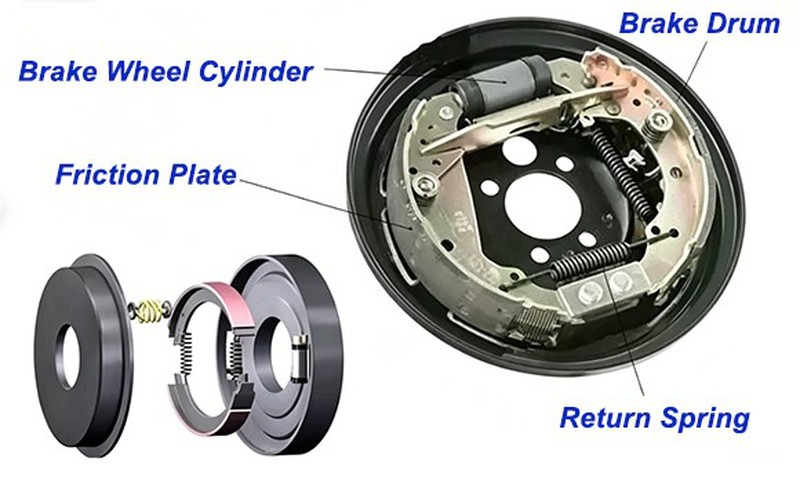
Even with modern electronics, the core principle remains unchanged. A brake master cylinder converts mechanical pedal force into hydraulic pressure. That pressure travels through brake fluid (DOT 3, 4 or 5.1) inside steel or flexible hoses to wheel cylinders at each wheel. Inside a drum brake, the wheel cylinder pushes two brake shoes outward against a rotating brake drum. Friction slows the wheel. When you release the pedal, return springs pull the shoes back, leaving a small clearance (typically 0.25–0.5 mm) to avoid drag.
This is where our products live – the master cylinder and every wheel cylinder. Their internal seals, pistons, and bore finishes directly determine pedal feel, braking balance, and leak‑free service life.

3. Types of Brake Systems – Why Multiple Circuits Exist
Modern vehicles use dual‑circuit hydraulic systems for safety. If one circuit loses pressure (e.g. a cut hose or leaking wheel cylinder), the other circuit still provides braking – usually about 50% of normal performance. There are three common layouts:
- Front‑Rear split – one circuit serves both front brakes, the other both rear brakes. Simple, but a front circuit failure leaves only rear brakes, which can cause instability.
- Diagonal split – each circuit connects one front and one diagonally opposite rear brake. A single failure still gives one front brake (essential for steering control).
- Dual wheel cylinders on the same axle – each circuit operates one of two wheel cylinders on the same brake. This is rare today but offers fail‑safe redundancy.
From a product perspective, understanding the layout helps you recommend the correct master cylinder (e.g. tandem master cylinders with two separate chambers) and identify which wheel cylinder belongs to which circuit.

4. Master Cylinder – The Heart of the Hydraulic System
The tandem master cylinder (two chambers in one housing) is standard on virtually all modern vehicles. Its genius is in how it handles failure:
- If the rear circuit leaks, the rear piston moves forward until it mechanically pushes the front piston – so front brakes still work.
- If the front circuit leaks, the rear piston builds pressure alone, and the front piston bottoms out without pressure loss.
Common failure signs: brake pedal sinks slowly to the floor (internal leak), or a visible fluid leak under the master cylinder.

5. Wheel Cylinders – Small Part, Big Responsibility
Wheel cylinders come in two basic forms:
- Double‑piston – pistons push both brake shoes outward. Common on rear drum brakes and some front drums.
- Single‑piston – one piston pushes a primary shoe; the secondary shoe is actuated via an adjuster or linkage. Often
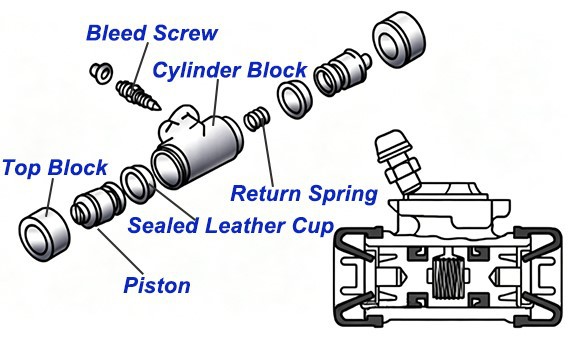 found on light commercial vehicles.
Inside each wheel cylinder, a piston, rubber cup seal, and adjuster (sometimes a threaded "tappet" or eccentric cam) work together. The adjuster compensates for lining wear. A seized adjuster is a frequent complaint – the brake feels low or pulls to one side.
Always replace wheel cylinders in pairs on the same axle. A leaking cylinder on one side contaminates the shoes and drum, leading to uneven braking.
6. Drum Brake Types – Why Different Designs Exist
Not all drum brakes are the same. The arrangement of shoes, pivot points, and wheel cylinders dramatically changes braking force, stability, and sensitivity to friction material.
- Duo‑servo (double self‑energizing) – highest forward stopping power. One shoe pushes the other via a floating link, multiplying force. Used in rear brakes of many Asian and American cars. Poor reverse braking.
- Single self‑energizing – moderate forward gain, very poor reverse. Only for some front drum applications.
- Twin leading shoe – two leading shoes (both self‑energising) in forward direction. Balanced, but becomes twin trailing in reverse. Found on some European front drums.
- Leading‑trailing shoe – one leading, one trailing. Equal performance forward and reverse. Simple, cheap, and still common on rear axles of small cars.
- Twin trailing shoe – lowest output but most consistent with friction changes. Rare; used where stability outweighs raw power (e.g. some trailers).
For the aftermarket, the leading‑trailing and duo‑servo types dominate.
7. Brake Balance and the "Balanced vs Unbalanced" Concept
In a leading‑trailing brake, the two shoes push the drum with different forces. The drum experiences a net radial load – that is an unbalanced design. It adds stress to the wheel bearings but is acceptable for light vehicles.
In twin leading, duo‑servo, and twin trailing brakes, the shoes are arranged symmetrically so their radial forces cancel out. These are balanced brakes. They are kinder to bearings and preferred for heavier or higher‑speed vehicles.

8. Brake Adjustment – The Often‑Ignored Money Saver

Drum brakes need periodic adjustment to maintain the correct shoe‑to‑drum clearance (0.25–0.5 mm). Too little clearance → drag, overheating, and premature lining wear. Too much clearance → long pedal travel, delayed braking, and a spongy feel.
Most modern drum brakes have self‑adjusters (ratcheting mechanisms activated during reverse braking). But self‑adjusters fail due to rust, broken springs, or worn cams.
Market Realities and Common Failure Patterns
From years of handling warranty returns and customer calls, here is what actually fails in hydraulic brake systems:
- Master cylinder – internal seal wear (pedal creep) or bore corrosion (visible in humid climates).
- Wheel cylinders – external fluid leaks past the rubber dust boot, often due to pitted bores from old fluid.
- Adjusters – seized threads or stuck cams, especially in salt‑belt regions.
- Brake hoses – internal collapse causing brake drag or pull, often misdiagnosed as a wheel cylinder problem.