


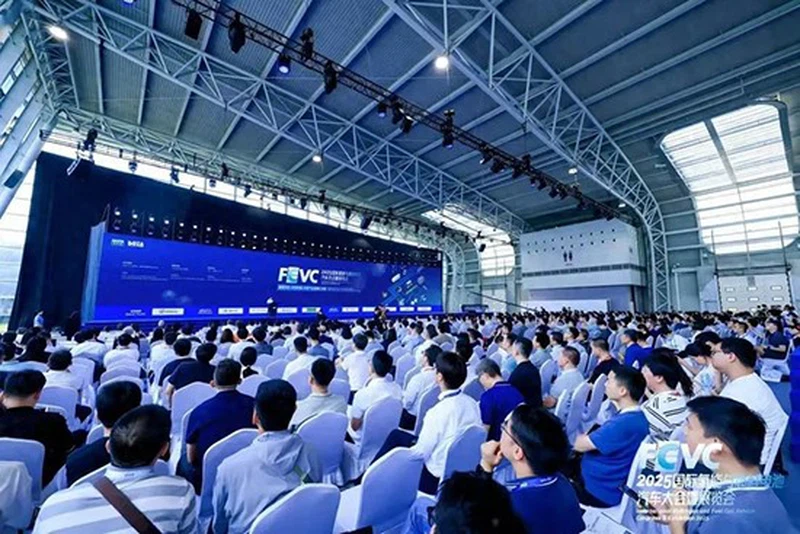
Shanghai, July 2025 – Industry leaders at the 2025 International Hydrogen and Fuel Cell Vehicle Congress (FCVC) projected 2030-2035 as the pivotal window for hydrogen's economic viability and mass adoption. While hydrogen is crucial for decarbonizing transport-especially heavy-duty trucks-scaling requires overcoming cost barriers, tech gaps, and policy coordination.

🔋 Key Industry Projections
- 2030-2035 Timeline: Experts from Boston Consulting Group and State Power Investment Corp. (SPIC) forecast cost-competitive "green hydrogen" within this period, triggering rapid industry growth.
- $1.4 Trillion Market: Academician Ouyang Minggao (Tsinghua University) predicted China's renewable-hydrogen chain will hit ~$1.4T (¥10T) by 2060, with 2030 marking the "explosive phase" of its clean energy revolution.
- 2025: Critical Foundation Year: Hailida Global CEO Shen Junhao emphasized 2025 as vital for policy planning and achieving economic scalability, positioning China as a global hydrogen innovation leader.
⚠️ Persistent Challenges
💱 Cost & Scale: SAIC VP Zu Sijie cited "economic uncompetitiveness" as the core barrier. Fuel cell vehicles need ~50% cost reduction to match diesel alternatives.
🛑 Policy Gaps: UNIDO's Petra Schwager urged unified standards, regulatory reform, and "green premiums" to attract capital. Zu Sijie warned against post-demonstration "policy voids."
🔧 Tech Bottlenecks: Storage, transportation, and material costs dominate expenses. Hyundai's Shin Seung-kyu and Toyota's Akira Manabe stressed affordability and infrastructure as prerequisites for million-unit deployments.
🚀 Pathways to Scalability
🤝 Cross-Industry Synergy:
- World Bank's Michelle Carvalho called for integrated supply chains involving financiers, tech firms, and energy giants.
- Canada Hydrogen's Pranav Chandrasekar emphasized "global partnerships" and demand-driven R&D.
⚙️ Tech & Engineering Leaps:
- China Automotive Eng. Research Inst. (CAERI) prioritized resolving storage/safety testing gaps.
- France's Air Liquide backed liquid hydrogen for efficient transport; Rare Earth Group advocated low-pressure solid-state storage.

🚛 Niche-First Commercialization
- Guochuang Hydrogen's Yao Ronghua confirmed hydrogen trucks' viability in ports, logistics, and closed industrial loops.
- Wuhan Ship Design Institute's Tang Wenjun targeted maritime applications, urging regulatory updates and cost cuts.
🌐 Beyond Vehicles: Hydrogen's Horizon--Innovation spans new frontiers
- Ships & Trains: Hydrogen fuel cells are being trialed for vessels and high-speed rail (China Academy of Sciences).
- Grid Integration: Ouyang Minggao highlighted hydrogen's role in "renewable energy storage" for power grids.
- Emergency & Heavy Transport: Viriginia Hydrogen's Pan Feng noted advantages for long-haul trucks, cold-chain logistics, and emergency vehicles (e.g., ambulances, fire trucks).
💡 The Way Forward
CAERI's Fang Haifeng distilled the mandate: "Government-industry collaboration is non-negotiable. Leverage scale, target strategic applications, and accelerate competitiveness." With 2025 policies setting the stage, 2030 looms as hydrogen's make-or-break decade.