


The consistency of braking performance is one of the indicators for evaluating a vehicle's braking performance. It mainly refers to the characteristic of a vehicle maintaining its cold-state braking effectiveness under conditions such as high-speed and high-intensity braking, continuous braking on long downhill slopes, and driving through water. This performance is primarily expressed by heat fade resistance and water fade resistance.
Ⅰ. Brake Heat Fade Test
During vehicle braking, the vehicle's kinetic energy is converted into heat energy by the brakes and absorbed, causing the friction material of the brakes to heat up. This heating reduces the friction coefficient, leading to a decline in braking performance. Therefore, a brake heat fade test, also called Type I Test, is conducted in accordance with national standards.
The test is conducted sequentially through the following steps: brake heating process, hot state performance test, and recovery performance test.
1.1. Brake Heating Process
Using the highest gear, conduct two Type 0 tests with the initial speed V1 as specified in Table 6-3 to determine the control force or line pressure required to achieve a deceleration of 3 m/s² when the vehicle is fully loaded. It should also be confirmed that the vehicle speed can be reduced from vv to vv within the specified time interval Δt.
Afterward, using the determined force, begin braking when the vehicle speed is vv, ensuring that the vehicle achieves an average deceleration of 3 m/s². The braking is released when the speed drops to V2. The vehicle should quickly return to V1 using the most favorable gear, and the highest gear speed V1 must be maintained for at least 10 seconds. Braking is then initiated again, ensuring that the time interval between the two braking actions equals Δt. A timing device should start or reset at the first braking operation.
Repeat the above "brake-release brake" process as specified in Table 1-1.
For vehicles equipped with electric regenerative braking systems, the state of charge of the power battery at the start of the test must ensure that the braking force generated by the regenerative braking system does not exceed the minimum level guaranteed by the system design.
Table 1-1 Brake Heating Test Conditions
|
Vehicle category |
Test conditions |
|||
|
Initial braking speed V1/ (km/h) |
Final braking speed V2/ (km/h) |
Braking cycle period Δt/ s |
Number of braking actions N |
|
|
M1 |
80% Vmax≦120 |
V1/2 |
45 |
15 |
|
M2 |
80% Vmax≦100 |
V1/2 |
55 |
15 |
|
N1 |
80% Vmax≦120 |
V1/2 |
55 |
15 |
|
M3,N2,N3 |
80% Vmax≦60 |
V1/2 |
60 |
20 |
Note:Vmax refers to the vehicle's maximum design speed; Δt indicates the time interval between the start of one braking action and the start of the next braking action.
1.2. Hot State Performance Test
After the final braking process in the aforementioned brake heating procedure, the hot-state braking performance of the service braking system can be measured. The vehicle, with its power unit disengaged, should immediately accelerate to the Type 0 test speed, and the average control force applied must not exceed the control force actually used in the fully loaded Type 0 test.
Under conditions where no wheel lockup occurs, the hot-state performance must not be less than:
60% of the actual performance achieved in the fully loaded Type 0 test.
75% of the specified performance in the Type 0 test (80% for commercial vehicles).
For vehicles equipped with electric regenerative braking systems, a cold-state braking test should also be conducted at the same speed as the hot-state test for comparison. The state of charge of the power battery must be adjusted to an appropriate level to ensure that the braking force generated by the regenerative braking system is close to that observed in the hot-state test.
If a vehicle achieves 60% of the Type 0 test performance under the control force of the Type 0 test but does not reach the specified performance of 75%, a higher control force, not exceeding 500 N (700 N for commercial vehicles), can be applied to further perform the hot-state performance test. Both test results should be recorded in the test report.
1.3. Recovery Performance Test
After the hot-state performance test, immediately perform four parking braking actions at an average deceleration of 3 m/s² from a speed of 50 km/h with the power unit engaged. A distance of 1.5 km is allowed between the start of each braking action. After each braking action, the vehicle should immediately accelerate to 50 km/h in the shortest time and maintain this speed until the next braking action.
At the end of the recovery process, immediately accelerate to the Type 0 test speed and measure the recovery performance of the service braking system with the power unit disengaged using an average control force not exceeding that of the corresponding Type 0 test.
The recovery performance must not be lower than 70% of the Type 0 test result with the power unit disengaged and must not exceed 150%.
For vehicles equipped with electric regenerative braking systems, the recovery test should be conducted under conditions where no regenerative braking components are involved in the braking process.
Allow the brake to cool to ambient temperature and confirm that the brakes do not stick. For vehicles equipped with automatic wear-compensation devices, check whether the wheels can rotate freely after the hottest brake has cooled to 100°C.
1.4. Evaluation Indicators
The key indicator for evaluating a brake's resistance to heat fade is the braking efficiency fade rate, defined as:

Ⅱ. Water Fade Brake Test
When the brakes are exposed to water, a water film forms on the brake surface, reducing the friction coefficient and thus decreasing braking performance-this phenomenon is called water fade. The water fade brake test assesses the resistance to water fade, and its performance is evaluated by the fade rate. A smaller fade rate at the same braking performance indicates stronger resistance to water fade.
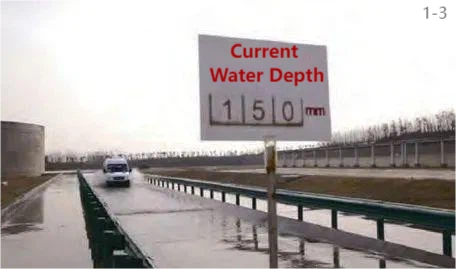
Figure 1-3 shows a passenger vehicle undergoing a water fade test.
Test Procedure
The basic concept and operational key points of the water fade test are similar to those of the brake heat fade test. It consists of three steps: the baseline test, the water immersion test, and the recovery test.
2.1. Baseline Test
Initial braking speed: 30 km/h;
Final speed: 0;
For vehicles with a maximum total mass ≤ 3500 kg, the braking deceleration should be 4.5 m/s².
For vehicles with a maximum total mass > 3500 kg, the braking deceleration should be 3.0 m/s².
The initial brake temperature must not exceed 90°C, and the vehicle performs three braking actions. During the test, measure braking deceleration, brake pedal force or brake line pressure, and the initial brake temperature.
2.2. Water Immersion Test
Drive the test vehicle into a water trough so that the depth of water immersion exceeds the wheel radius, ensuring the brakes remain in a non-braking state. Then, drive the vehicle back and forth through the water trough at a speed of less than 10 km/h for 2 minutes, and exit the water trough.
2.3. Recovery Test
The recovery test is performed 1 minute after the vehicle exits the water trough.
Initial braking speed: 30 km/h;
Final speed: 0.
For vehicles with a maximum total mass ≤ 3500 kg, the braking deceleration should be 4.5 m/s².
For vehicles with a maximum total mass > 3500 kg, the braking deceleration should be 3.0 m/s².
The cooling speed is 30 km/h, and the braking interval distance is 500 m. During the test, record the brake pedal force, brake line pressure, and braking deceleration.
Throughout the test, measure the braking deceleration and record either the brake pedal force or brake line pressure. Calculate the fade rate to evaluate the brake's resistance to water fade.
Note: This text is excerpted from the "14th Five-Year Plan" textbook Testing of New Energy Vehicles, published by the Ministry of Industry and Information Technology of China. The book can serve as a textbook for disciplines such as vehicle engineering, new energy vehicles, traffic engineering, and related fields in higher education, and can also be used as a reference for researchers, engineers, and management personnel.
Publisher: China Machine Press
Author: Zhang Daisheng