


Abstract: With the development of automobile industry, corrosion resistance test plays an important role in test detection. Through the evaluation and analysis of the corrosion resistance test, it is studied whether the vacuum booster with brake master cylinder assembly meets the purpose of the corrosion resistance test standard. Based on the "QFC-CA04-005-2015 Brake Vacuum Booster with Brake Master Cylinder Assembly" standard, the test was completed using a salt spray corrosion test chamber, a high and low temperature damp heat test chamber and a vacuum booster high and low temperature comprehensive performance test bench.
1. Test Background
Today, with the increasing development of the automobile industry, corrosion resistance tests play an important role in the evaluation of automobile design, environmental research, new product development, material selection and quality control. In order to evaluate whether the existing vacuum booster with brake master cylinder assembly meets the standard requirements, the samples are verified and analyzed through corrosion resistance tests.
2. Corrosion Resistance Test Items
According to the《QFC-CA04-005-2015 Brake Vacuum Booster with Brake Master Cylinder Assembly》standard, the test items include corrosion resistance test, air tightness test, input and output characteristic test, and heavy load strength test.
3. Start The Experiment
(1) Corrosion Resistance Test
Test process: First, connect the push rod protective sleeve and vacuum hose, and simulate the real vehicle conditions to fix the vacuum booster with brake master cylinder assembly; then, carry out the corrosion resistance test in sequence, the cycle diagram is shown in Figure 1 . Finally, carry out 30 cycles according to Figure 1, and the cyclic corrosion test is mainly used to verify parts with high anti-corrosion requirements.

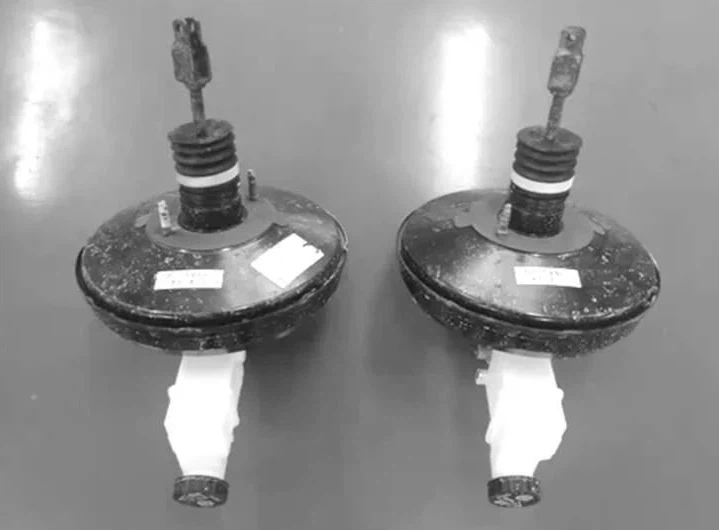
Test results: This standard only requires that the performance and strength after the corrosion resistance test meet the requirements, so the corrosion conditions of each six cycles of this test are provided. The test results are shown in Table 2, and the test samples are shown in Figure 2.
|
Days |
Sample No. 1 |
Sample No. 2 |
||
|
Corrosion degree |
Rust degree |
Corrosion degree |
Rust degree |
|
|
6th day |
2% |
2% |
2% |
2% |
|
12th day |
3% |
3% |
2% |
4% |
|
18th day |
3% |
4% |
2% |
8% |
|
24th day |
3% |
8% |
2% |
12% |
|
30th day |
3% |
15% |
2% |
18% |
Air Tightness Test
Test process: First, install the sample on a rigid bench according to the actual vehicle method, and connect the vacuum source, sensor and load; then, when the vacuum degree reaches 66.7 kPa, cut off the vacuum source, so that the vacuum booster is in a non-operating state , measure the vacuum drop within 15 s; finally, apply the maximum boost point load to the control valve push rod, cut off the vacuum source, and measure the vacuum drop within 15 s.
Test results: This standard requires a vacuum pressure drop ≤ 3.3 kPa for the air tightness test. The test results and judgments are shown in Table 3.
|
Sample No. |
Standard Request |
Test result/kPa |
Judgement Result |
|
|
Sample No. 1 |
Vacuum pressure drop: ≤3.3kPa |
no action |
0.668 |
PASS |
|
In operation |
0.976 |
PASS |
||
|
Sample No. 2 |
no action |
0.137 |
PASS |
|
|
In operation |
0.792 |
PASS |
||
I/O Characteristic Test
Test process: First, install the sample on a rigid bench in the manner of a real vehicle, and reconnect the vacuum source, sensor and load; then, when the vacuum reaches 66.7 kPa, apply a load to the control valve at a speed of 0.05 mm/s On the push rod, measure the starting force, jump value and assist ratio; finally, sort out the test data and make a judgment against the standard.
Heavy Load Strength Test
Test process: First, install the sample on the rigid bench according to the actual vehicle method, and reconnect the vacuum source, sensor and load; then, when the vacuum reaches 66.7 kPa, carry out the heavy load strength test in sequence.
4.Conclusion
Through this test, it is evaluated that this batch of vacuum booster with brake master cylinder assembly is qualified.
Automobile designers should have the following knowledge to carry out excellent protection design, that is, corrosion principle and corrosion form, automobile materials and the influence of various factors on materials, corrosion protection methods and their effects, and the relationship between the shape of various parts of the automobile and corrosion.