


Most modern cars have dual-line braking systems, but a few low-speed trucks and agricultural vehicles still use single-line braking systems in order to reduce costs.
Small operating force, vacuum booster is used. Generally people are used to refer to single-pipe vacuum booster as vacuum booster, vacuum booster and vacuum booster
The functions of the two devices are exactly the same, except that the control mechanism (atmospheric valve and vacuum valve) of the single-line vacuum booster for trucks or agricultural vehicles is designed to reduce production costs.
This design is outside the booster. The vacuum booster control mechanism (atmospheric valve and vacuum valve) of the double pipeline of the car is inside the vacuum booster.
1. The role of vacuum booster
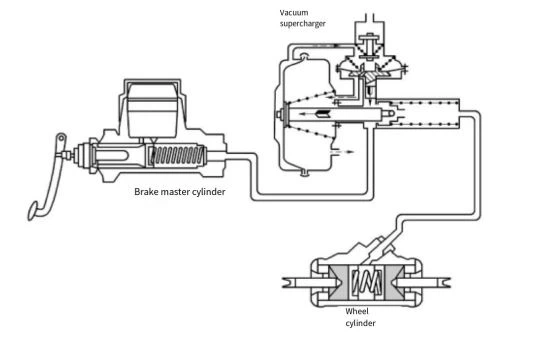
The vacuum energy is used to pressurize the oil output from the master cylinder, and the control device is operated by the hydraulic pressure output from the master cylinder by the brake pedal mechanism.
Vacuum superchargers are used in indirect control servo brake systems, mainly used in light trucks, such as low-speed trucks with two axles and six wheels or two axles and three wheels.
2. Working principle of vacuum booster
The working principle of the vacuum booster is shown in Figure 4-3.
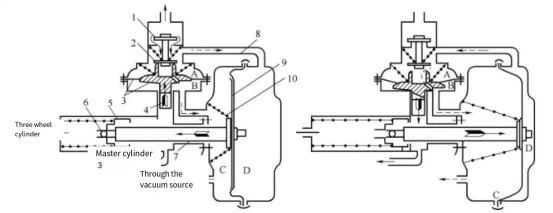
Figure 4-3 Working principle diagram of vacuum booster
(a) Depress the brake pedal: (b) Release the brake pedal
1 an air valve: 2 a vacuum valve: 3 a vacuum valve diaphragm: 4 a control valve piston: 5 a booster cylinder piston: 6 a stop valve; 7 a push rod: 8 a breather tube: 9-a servo air chamber membrane
Sheet: 10 a servo air chamber diaphragm return spring;
A-Control valve upper chamber; B-Control valve lower chamber; C-Servo chamber left chamber; D-Servo chamber right chamber
1) When the brake pedal is depressed
The brake fluid is fed into the booster cylinder from the master cylinder, and the shut-off valve 6 is in the open state at the beginning, so the brake fluid can enter the front through the hole on the piston of the booster cylinder.
Rear brake wheel cylinders. At this time, the wheel cylinder pressure is equal to the master cylinder pressure. At the same time, the pressure oil input to the booster cylinder acts on the control valve piston 4, pushing
Moving the diaphragm seat_up, first close the vacuum valve 2 to isolate the upper chamber A of the control valve from the lower chamber B, and then open the air valve 1. So the air passes through the air
The filter flows into the upper cavity A of the control valve and the right cavity D of the servo air chamber (Figure 4-3 (a)), which increases the pressure (that is, reduces the vacuum). While controlling
The vacuum degree in the lower chamber B of the control valve and the left chamber C of the servo air chamber remains unchanged. Under the action of the pressure difference between the C and D chambers, the servo chamber diaphragm 9 drives the push rod 7
Move to the left to make the stop valve 6 abut against the valve seat of the booster cylinder piston 5 and isolate the brake master cylinder from the left cavity of the booster cylinder. At this time, the piston in the booster cylinder
There are two forces: one is the hydraulic force from the brake master cylinder; the other is the thrust from the push rod. Therefore, the left cavity of the booster cylinder and each wheel cylinder
The hydraulic pressure is higher than the hydraulic pressure of the master cylinder, so it has a booster effect.
As the vacuum in the A and D chambers decreases, the diaphragm and valve components of the control valve gradually move down. The vacuum degree in the A and D chambers is reduced to a certain value
When the air valve is closed, the vacuum degree will be maintained at a certain-stable value, which depends on the input control pressure, that is, the pressure of the master cylinder. And control the pressure
It also depends on the pedal force and pedal stroke, so the driver's force on the pedal plays a decisive role in the braking strength.
2) When raising the brake pedal
When the brake pedal rises for a certain distance [Figure 4-3 (b)], that is, when the pressure of the master cylinder drops by a certain value, the equilibrium state of the control valve is destroyed, and the control valve
The piston 4 and the diaphragm seat move down, and the vacuum valve is opened, so the pressure of the A and D chambers is reduced, so that the pressure difference between the D and C chambers is reduced. Booster cylinder output pressure
It is kept at a low value, so that the braking strength is weakened. When the brake pedal is completely relaxed, all moving parts are restored under the action of their respective return springs.
Return to the original position.
3) Failure replacement
If the vacuum booster fails or the pipeline leaks and the vacuum is zero, the shut-off valve 6 in the booster cylinder will remain open to make the master cylinder and the brake wheel
The oil path between the cylinders is unobstructed. The entire system is equivalent to working without a supercharger, but the pedal force required is greater.