


Cars are made for speed, and people can design and build faster cars, but why not? It's not that the engine horsepower is not enough, but the braking technology can't keep up. Without braking, there is no speed, and the maximum speed of the car is always limited by the braking performance. This paper focuses on the current mainstream braking forms of automobiles, and understands the structure and components of the braking system and their characteristics together.
Brake form
At present, there are two main types of brakes in domestic automobiles: drum brakes and disc brakes.

Their braking principle is the same, that is, the fixed non-rotating part (brake shoe/pad) presses the part (brake drum/disc) that rotates with the wheel with a certain force, forcing the wheel to brake.
drum brake
Components: It is composed of brake drum, brake shoe, friction lining, return spring, brake wheel cylinder and other components.

The brake drum is made of cast iron and looks like a drum, hence the name of the drum brake.
Braking process: When the brake pedal is stepped on, the brake fluid enters the brake wheel cylinder through the brake oil pipe, and pushes the brake shoes to move up and down in two directions. The inner side produces friction, which produces a braking effect.
Features: The advantages of drum brakes are low manufacturing cost, stable work and easy maintenance. Therefore, it is common in the rear wheels of economical cars.
disc brake
Components: brake disc, brake caliper, brake pad, piston and brake wheel cylinder and other components.
Braking process: When the brake pedal is stepped on, the brake fluid passes through the brake oil pipe and passes through the brake wheel cylinder to squeeze the piston to push the brake caliper.
The friction pads on the calipers rub against the brake discs on the wheels to produce a braking effect.
Features: Beautiful appearance, light weight, high manufacturing cost, fast heat dissipation, and good braking effect.
Especially now the more and more common ventilated disc brakes, ventilated pads and vents are designed in the middle of the brake disc, which improves the heat dissipation capacity of the brake disc, so it is used in sports cars or racing cars. It is extremely common.

Porsche 911 disc brake exterior
Ceramic brakes
Compared with ordinary brake discs, ceramic brake discs have the characteristics of light weight, high temperature resistance and wear resistance. Ordinary brake discs are prone to high heat and thermal recession under full braking, and the braking performance will be greatly reduced, while ceramic brake discs have good thermal recession resistance, and their heat resistance performance is many times higher than that of ordinary brake discs. . But its high cost makes it appear only on supercars.
Parking brake
Generally, the parking brake of a car is also called the handbrake, which is usually arranged on the rear wheels in the form of drum brakes, so only the two rear wheels are braked when the handbrake is pulled. In some high-end models, the electronic handbrake gradually replaced the traditional handbrake. Electronic handbrakes are roughly divided into two types, one is the wire rope pulling type, that is, the electric motor is used to directly replace the previous manual wire pulling. The second is the integral caliper type, that is, the use of the electric motor and the deceleration mechanism to directly act on the brake disc to realize the parking brake.

Traditional cable handbrake

Electronic handbrake
Brake booster
Even if there is hydraulic assistance to help the driver brake, but for women who are not very powerful, if they do not have enough strength to step on the brake pedal, it will be very dangerous in an emergency.
The brake booster is also called a vacuum booster, which looks like a frying pan. The working principle is very simple, that is, the inner chamber of the booster is divided into two by the air chamber diaphragm, and the air chamber on the side away from the brake pedal is connected with the intake manifold of the engine with a pipe to form negative pressure. When the brake pedal is stepped on, the air chamber near the pedal enters the atmosphere, so the air pressure difference of the atmosphere is used to push the brake master cylinder parts to achieve the effect of brake boosting.

Brake booster appearance
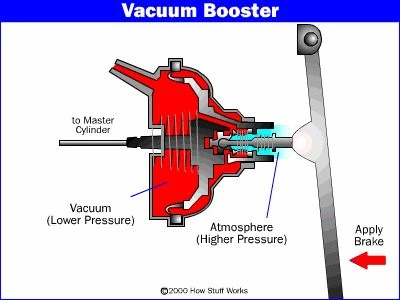
The schematic diagram of the brake booster, the red part is the negative pressure state. When the brake pedal is stepped on, the air pressure on the right side of the air chamber diaphragm is larger than the left side, so there is an air pressure difference.
Electronic control system of braking system
In order to ensure the driver's braking safety and enhance the driving pleasure, engineers have equipped the car with some advanced electronic assistance systems.
EBA-Emergency Brake Auxiliary System
The emergency braking assist system is used to automatically increase the braking force in an instant when the on-board computer ECU finds that the driver performs emergency braking, so as to prevent a dangerous situation due to insufficient power of the driver.
When the time of releasing the accelerator and stepping on the brakes received by the sensor, the speed and force of stepping on the brakes meet the requirements, the ECU will immediately start the emergency braking measures, and the braking force will be fully exerted in just a few milliseconds. The driver has a much faster time to press the brake pedal to the bottom, which can
ABS-Anti-locked Braking System
The anti-lock braking system. It is an automobile safety control system with the advantages of anti-skid and anti-lock, etc. It has been widely used in automobiles. ABS is mainly composed of ECU control unit, wheel speed sensor, brake pressure regulating device and brake control circuit.
During the braking process, the ABS control unit continuously obtains the speed signal of the wheel from the wheel speed sensor and processes it to determine whether the wheel is about to be locked. The characteristic of ABS braking is that when the wheel tends to the critical point of locking, the pressure of the brake cylinder does not increase with the increase of the pressure of the main brake cylinder, and the pressure changes near the critical point of locking.
If it is judged that the wheel is not locked, the brake pressure regulating device does not work, and the braking force will continue to increase; if it is judged that a wheel is about to lock, the ECU sends an instruction to the brake pressure regulating device to close the brake cylinder and brake wheel. If it is judged that the wheel is locked and slipping, it will send a command to the brake pressure regulating device to reduce the oil pressure of the brake wheel cylinder and reduce the braking force.
ESP-Electronic Stability Program
The ESP system is actually an extension of the functions of ABS (anti-lock braking system) and ASR (drive wheel anti-skid system), which can be said to be the highest form of anti-skid devices in current automobiles. It is mainly composed of control assembly and steering sensor (monitoring the steering angle of the steering wheel), wheel sensor (monitoring the speed and rotation of each wheel), side slip sensor (monitoring the state of the vehicle body rotating around the longitudinal axis), lateral acceleration sensor (monitoring when the car turns centrifugal force) etc. The control unit judges the running state of the vehicle through the signals of these sensors, and then sends out control commands.

When an obstacle suddenly appears in front of the vehicle, the driver must turn to the left quickly. At this time, the steering sensor transmits this signal to the ESP control assembly. will run directly to the obstacle. At this time, the ESP system will instantly brake the rear wheels urgently, so that the reaction force required by the steering can be generated, so that the car can drive according to the steering intention.
If you steer in the opposite direction in the left lane where the car is driving after turning, the car runs the risk of oversteering, with so much torque to the right that the rear of the car swings to the left. At this time, the ESP system will brake the left front wheel, the torque will be reduced, and the car will turn smoothly.